REMEMBER THE PAST.
LIVE FOR THE FUTURE.
“After you get through the first three chapters, do not make any plans.”
Prelude
The Sacred Nod
Japan is a land of earthquakes—unpredictable and devastating. Sometimes the ground gently shudders in a last slipping of unseen forces deep below the surface. Rarely noticed by everyday people, such quivers can be passed off as the wind simply rustling the branches of a tree. This was such a day. Only those closest to the epicenter felt the tremor that would lead to a cataclysm unlike anything the world had ever seen.
December 1, 1941. The Imperial Palace, Tokyo, Japan.
The weight of seventy-three million souls rested on the shoulders of the forty-two-year-old Emperor Hirohito. The boyish leader, with his sparse mustache and frameless glasses, sat motionless on a raised platform backed by a gilded screen. Assembled before him were the chief leaders of Imperial Japan. He exuded unquestioned authority in his navy-blue uniform, replete with medals, a gold shoulder braid, and a red sash across his chest. Without a hint of emotion, he contemplated the petitions of his nineteen most trusted officials, separated into military and civil advisors at two extended tables facing one another. Floor-length burgundy fabric patterned with gold perfectly draped both tables.
From Hirohito’s earliest memories, he had been saturated with the understanding that he was born not only the military and political leader of Japan, but to become their spiritual leader as well—a living god to whom his subjects owed absolute obedience. He watched intently as Prime Minister Major General Hideki Tojo rose from his seat, the silence pierced by the jangle of his medals and the squeak of his chair as it slid back on the parquet floor.
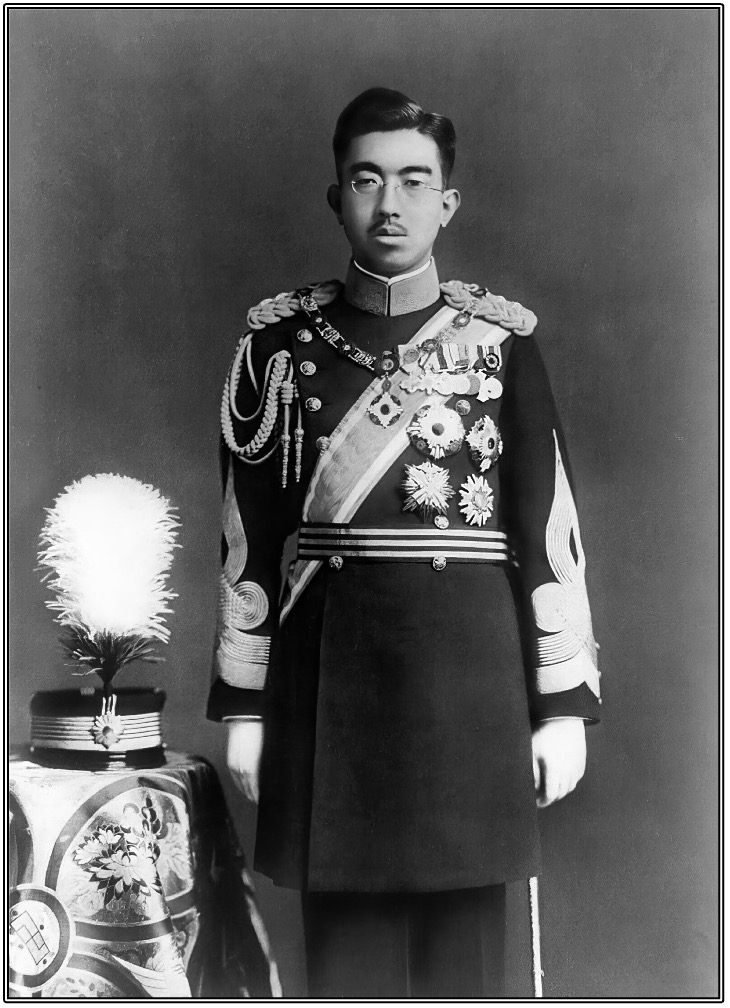
Emperor Hirohito in his full-dress uniform.
Tojo bowed deeply, then stood upright. Only a month earlier, his iconic visage had appeared worldwide on the cover of TIME magazine—bald head, broad mustache, and black, round-rimmed glasses. Officers and soldiers alike knew him as “The Razor” as much for his quick wit and decision-making as for his brutal military prowess. He patted his forehead with a handkerchief and pushed back his glasses. “Your Majesty,” he began in the stark silence, “you have heard the words of each of your advisors and commanders in this room. At the moment, our empire stands at the threshold of glory or oblivion. We tremble with fear in the presence of His Majesty.”
The emperor knew well why Tojo perspired, for he, too, was haunted by the recent report from their elite group of researchers who had delivered their unanimous conclusion: Japan could not sustain its war with China for more than five years and could never win an extended war with the United States, whose manufacturing capacity was twelve times that of Japan.
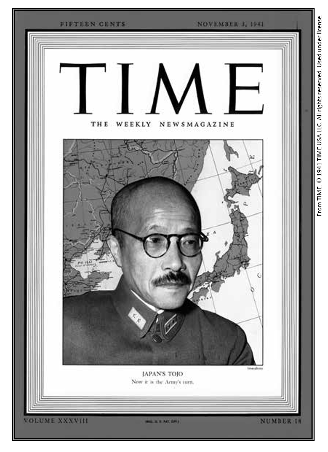
Prime Minister Hideki Tojo, November. 3, 1941.
Although he had dismissed the report and was supremely confident in Japan’s military preeminence, the communiqué unsettled him. Beginning a chess match with merely two pieces would yield better odds than starting an all-out war with the United States of America. Their agreed-upon strategy was solely to assault and cripple the Americans and quickly secure terms of mutual nonaggression, allowing Japan free reign in greater East Asia.
He clenched his fist, unable to shake from his mind the warnings of Fleet Commander Admiral Yamamoto, who fourteen months earlier had said, “To fight the United States is like fighting the whole world. Tokyo will be burnt to the ground three times before it’s over.”
Tojo’s eyes turned downward. “We subjects are keenly aware of the great responsibility we must assume from this point forward.”
The break of eye contact released the emperor to look upwards at the dark-coffered ceiling that permeated his council chamber with the scent of ancient wood. A final decision had to be made, and he knew it was his alone to make. He felt like a diver atop a cliff gazing at the churning surf below.
He’d already turned loose their task force of aircraft carriers from Hitokappu Bay five days earlier and, as Tojo spoke, they steamed for Hawaii at battle speed. But even now, he knew only a word from him would instantly turn them home.
The outcome of a war with the Americans could be disastrous, yet the apple on the tree enticed him. Germany had swept across Europe in a
blitzkrieg, virtually unopposed, and was now battering the doors of Moscow. Japan had allied itself with Germany and Italy and had no doubt that the Germans would be the ultimate victors of a European war that was all but over. This wasn’t the time to hesitate and get left behind. Negotiations to end the United States’ embargoes of oil and scrap iron had broken down and they needed raw materials. Besides, Hirohito’s acceptance of any terms from America would be perceived as a sign of weakness by his people.
“Once His Majesty reaches a decision to commence hostilities,”
Tojo said, “we will all strive to repay our obligations to him—to bring the government and the military ever closer together, to resolve that the nation united will go to victory, to make an all-out effort to achieve our war aims, and to set His Majesty’s mind at ease.”
Hirohito tapped his fingers in succession against the end of his armrest. He and his leaders had been furiously constructing a colossal war machine while the United States sat on the sidelines, bogged down by internal dissent as its outdated military deteriorated under a poor economy and the indecision of Washington. His nation was in the best position it had been in, or perhaps would ever be in, to establish its dominance over the Pacific and East Asia.
Japan was at its strongest, and America at its weakest. The Empire of Japan was finally poised for conquest and to secure its place in history.
Tojo remained standing as all eyes in the chamber turned slowly toward the emperor . . . waiting . . . waiting.
At times, Hirohito joined the conversation; but at other times, he restrained himself from uttering a single word during entire meetings. Such was the case on this occasion. Ever so slightly, he nodded with a crooked smile—and his feet left the cliff as he fell weightlessly down to the water far below. The precarious question of victory remained, but the pursuit of the answer was undeniable: millions would perish.
December 7, 1941 (December 8 in Japan). Early a.m. before dawn. The Pacific Ocean, 275 miles northwest of Oahu.
In the black of night, the Kido Butai smashed through heavy seas at full speed, due south. The carrier battle group was the world’s newest and most powerful naval fleet—6 carriers tightly packed with 414 attack aircraft, 2 battleships, 20 escort ships, and 23 submarines. The massive Akagi, equipped with two levels of hangars housing ninety-one planes, was the largest aircraft carrier the Imperial Japanese Navy had ever built and was the flagship of the First Air Fleet under the command of Vice Admiral Chuichi Nagumo—a meticulous planner, cautious to a fault.
Salt mist and the smell of aviation fuel hung in the air of the hangars as engineers in white jumpsuits feverishly unlashed aircraft from their moorings on the floor, unchocked the wheels of fighters and bombers, and began transferring planes to elevators to be raised to the dark flight deck. A steel hull gave a haunting screech as it twisted from the pounding waves. Engineers fastened eighteen-foot torpedoes and 1,760-pound, armor-piercing bombs to the bellies of Nakajima B5Ns, fit Aichi D3A dive-bombers with 550-pound bombs, and fed thousands of rounds of ammunition to Zero fighters.
In an organized frenzy, men coaxed aircraft into position onto waiting elevators. Planes began to fill the windblown deck, each engine coughing clouds of smoke and snorting blue flames from their exhaust pipes, rumbling to join the deafening thunder of a storm about to break.
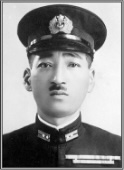
Lieutenant Commander
Mitsuo Fuchida
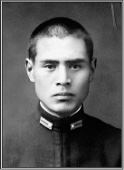
Lieutenant Commander
Minoru Genda
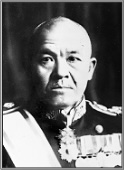
Vice Admiral
Chüichi Nagumo
At the front of the low-ceilinged briefing room crammed with men anxious for a fight, stood the senior flight commander of the First Air Fleet, First Carrier Division, the pilot who would lead the historic attack— Commander Mitsuo Fuchida. Facing his eager airmen seated upright and standing before gray walls, Fuchida stood proudly, his hands behind his back in his dark brown jumpsuit trimmed with a fur collar and overlaid with a brown, kapok-filled float vest. He had a narrow, dense mustache. A blackboard behind him displayed flight paths to islands, last-minute details, and exhortations of: “As the gods have given us victory in the past, so will they give us victory in the future!” and “Win or lose, you will fight and die for your country!”
Having anticipated this day for months, today his joy mixed with the fire in his eyes and the adrenaline in his veins.
“In the event we fail to destroy the aircraft on the ground,” Fuchida announced, “or we lose the element of surprise, I will give the signal for the dive bombers to begin the attack. Otherwise, the torpedo bombers will initiate, as planned.” He scanned the faces of his torpedo pilots who nodded.
He had longed and dreamed of this day of vindication before the eyes of the world.
Off to his side stood his fleet commander, the rather stocky Vice Admiral Nagumo, and beside him Fuchida’s long-time best friend and chief planner of the impending attack, Lieutenant Minoru Genda, in his officer’s uniform, strikingly handsome.
As the idling planes rumbled outside the door and their ship rose and fell in the turbulent sea, Fuchida sensed a powerful mixture of fatherly pride and deep compassion for the 146 young airmen before him, men he knew by name, men he had personally trained—all of them impatient, restless, serious—some whose mothers would weep when the day was over.
Under any other circumstances he would have forbidden his fliers from taking off in such stormy seas, but such was their destiny.
“Years of training and careful planning have brought us to this moment in time.” He paused to let his eyes penetrate the hearts of his fliers, then snatched his soft leather flight helmet from the table, pulled it over his head, and adjusted the goggles above his forehead.
“Our duty is not only to protect the untarnished past of our ancestors, but to annihilate the enemies of Japan and to establish a new order for the future, the imperial way!” Passion energized his body as he paced like a tiger eyeing an opening cage door. “This is our day, today, our opportunity to mark our place in history. The world will soon know that we are the new samurai. The Empire’s fate depends on the result of this battle. Let every man do his utmost!” He snapped to attention and threw both arms to the sky as the men leaped to their feet, then led his warriors into a resounding cheer, “Tenno Heika, Banzai! Banzai! Banzai!1
To the east, the edge of the dark blue morning sky glowed orange along the ocean horizon. Engineers sprinted between aircraft on the windblown deck while pilots and flight crews clambered into their idling planes.
Shuffling through a crowded passageway, Fuchida stared distantly at the floor as he fastened his chinstrap and scoured his mind for any details he may have overlooked. Glancing up, Genda’s face woke him from his thoughts. Airmen eased past them toward the angry chorus of attack planes. Fuchida lowered his hands and gazed deep into Genda’s eyes. This was it. There was no turning back.
1Literally, “Heavenly sovereign, ten thousand years.” Figuratively, “May the Emperor reign for ten thousand years.”
“I have read thousands of books, and this is by far the best-written, best story-telling book I have read.”
Part I
The Clouds of War
Chapter 1
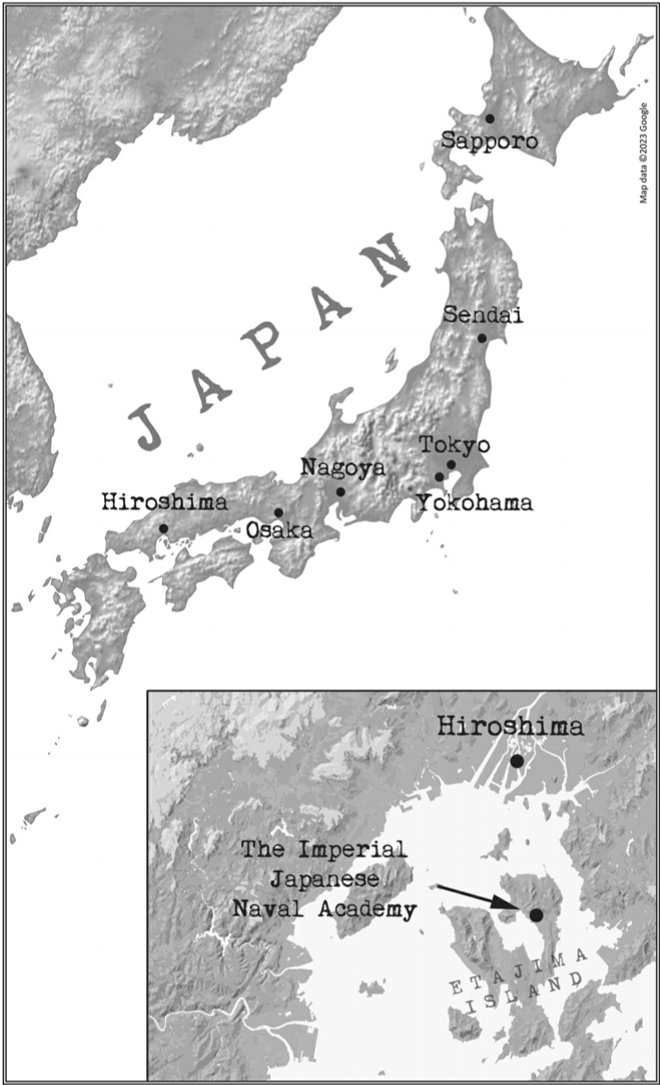
Nineteen years earlier, Spring 1922. The Imperial Japanese Naval Academy. Etajima Island, Hiroshima, Japan.
Light burst through the morning clouds in a stunning array of columns. It shone above a steep, densely green mountain ridge behind the long, two-story red brick building of the Imperial Japanese Naval Academy.
A Rising Sun Flag flapped loosely out front in the ocean breeze. Shirtless, barefoot cadets in white pants jogged past the young, clean-shaven Fuchida and Genda in their blue uniforms on their way to class.
Fuchida inhaled the morning hope. A new day. He studied the brick structure and reflected on the strange fact that each brick had been individually wrapped in paper and shipped 11,000 miles from their naval mentor, Great Britain. Looking up, the startling sunburst in the morning sky seemed strikingly similar to Japan’s own naval flag.
“The sun rises on you, Fuchi,” Genda said, staring at the sky.
Fuchida contemplated the golden sunlight piercing the clouds, then looked back at Genda with a smirk. “It’s only morning. Just wait until the afternoon.”
With the shriek of a commander’s whistle, the two quickly merged with other cadets heading to class past meticulously manicured pine trees, up the stone steps, and into the brick building.
The Imperial Japanese Naval Academy was for the elite—those being groomed for leadership in the growing naval force of Japan. Fuchida was exceptionally bright, if not a bit impulsive and cocky—a hands-on type of young man and, above all, passionate for his country. Genda possessed an equally sharp intellect but leaned more toward the strategic side of things. He strove to do things better—better than anyone else.
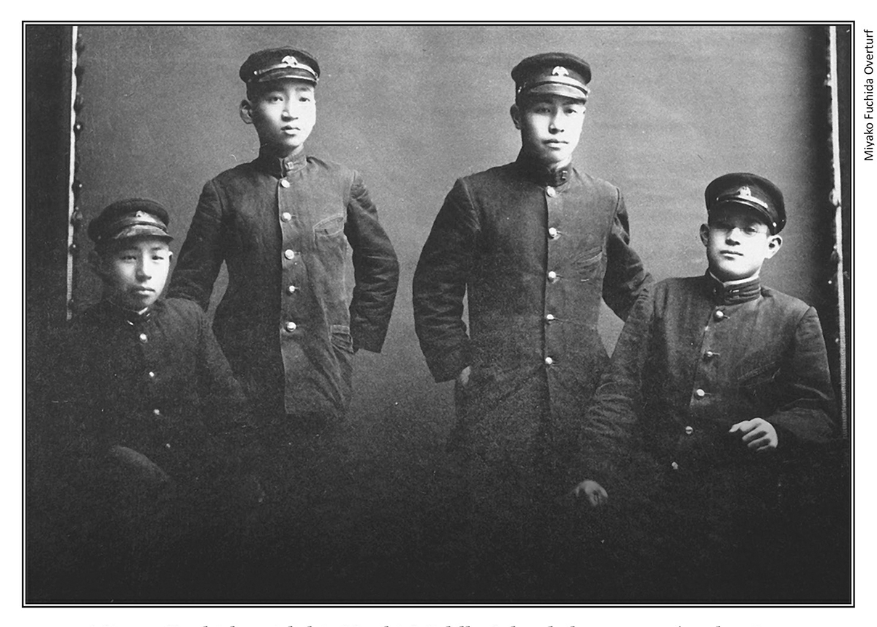
Mitsuo Fuchida with his Unebi Middle School classmates (at the time, a five-year program that included students through age sixteen), second from the left, age sixteen, February 1919.
Fuchida, aged nineteen, walked through the hallway among his classmates with a slight swagger that he’d earned. Mocked as a child by his classmates for his small size and shy demeanor, he had determined to prove them wrong. He didn’t feel lucky—he’d worked hard for his place, a place to which even his own friends and family never thought he’d arrive. Despite failing both the physical and academic examinations on his first attempts, he devoted hours to swimming, studying late into the night, and running—mercilessly disciplining himself to pass them both. And pass he did, gaining acceptance into the premier academy of the nation, an exclusive club. He’d bought his passage with sweat and sheer force of will, gaining rank among the top of his class.
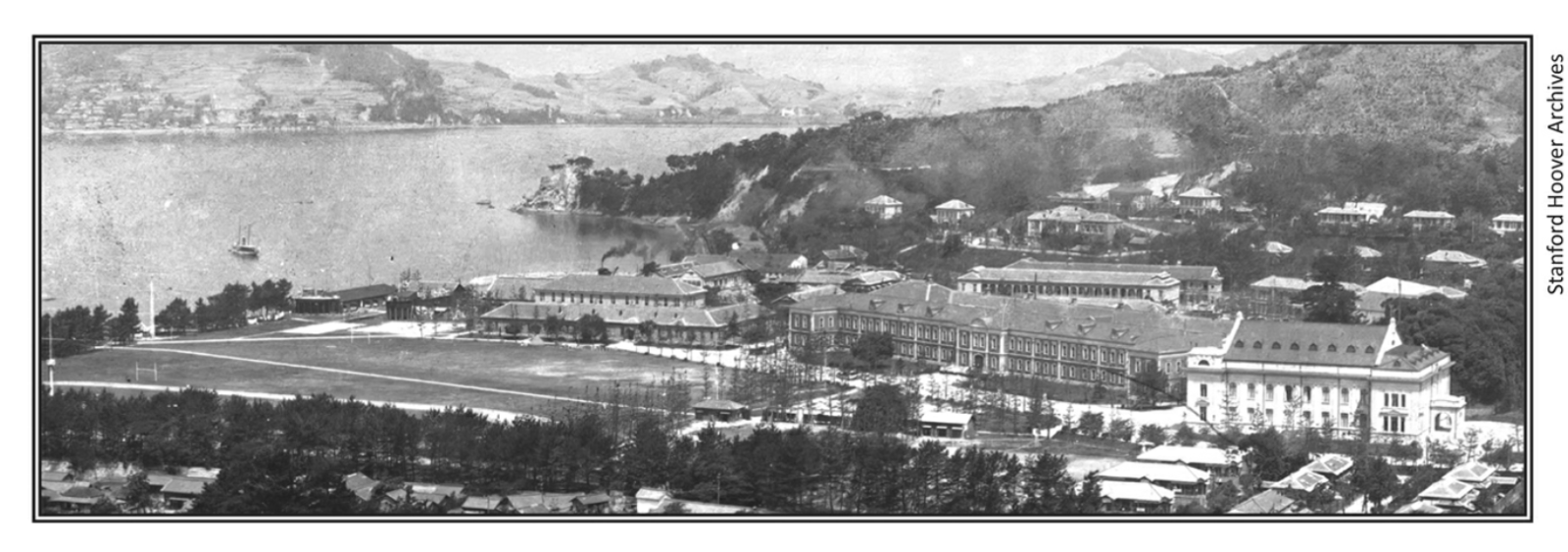
The Red Brick Students Hall, center right, at the Etajima Naval Academy, early 1920s.
Inside the schoolroom, cadets took notes, attentively cocking their heads to the words of their professor, Lieutenant Nakahama. Maps, charts, and ship illustrations adorned the walls; writing and diagrams filled the front blackboard.
“Submarines, destroyers, and now aircraft from our new carriers all lend their support to the heart of our fleet—our battleships.” He smacked his pointer onto a large profile of Japan’s newest battleship, the Mutsu. Fuchida had studied her well. She was less than a year old, armed with 8 massive guns which hurled one-ton shells over 23 miles—43,000 tons of modern military power, the pride of the Imperial Navy.
Lieutenant Nakahama gently laid the pointer across his desk and began to pace the perimeter of the classroom. “Continuing from yesterday, following the Great War in 1919, delegates from twenty-seven nations convened for the Paris Peace Conference to set terms for peace and to form the League of Nations. For the first time, Japan was recognized and invited as one of the five major powers. But was the League truly an organization for world peace—or just another means for Anglo-Saxon nations to extend their own power and influence?”
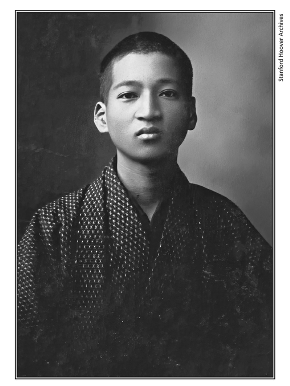
While studying for an entrance exam in Osaka, January 1920.
Fuchida’s eyes followed Nakahama to the side of the room where the professor adjusted the angle of the blinds.
“To clarify things, Japan offered the Racial Equality Proposal that simply declared all members be given equal and just treatment without regard to race or nationality. Despite the protests by some who declared that a colored person could never be equal to a white European, the proposal passed with a majority of votes—only to be set aside and defeated when it was ruled that an issue of this importance had to be unanimous. Do you know who made that decision?”
Genda raised his hand, and the professor nodded. “Sir, wasn’t that by President Wilson?”
Professor Nakahama brought his hands behind his back. “Indeed. The chairman of the committee, President Woodrow Wilson of the United States.”
Fuchida glanced over at Genda with disgust as Lieutenant Nakahama completed his circuit to the front of the class.
“Japan was invited to dinner, yes, but then given no place to sit.” He scanned across the faces of the cadets. “In the end, it was just as well that the proposal was defeated. The Yamato race has no equal on earth—unconquered for twenty-six hundred years.” For a moment the professor and Fuchida caught eyes, connected, and exchanged the slightest of smiles.
(Continued...)
Read what happens next in hardcover, Kindle, or Audible audiobook. The complete story — including over 300 photographs, maps, letters, and documents — is waiting for you on Amazon.